Microanalytical geochemist
I use high-resolution geochemical methods to work on problems across geology, palaeoclimate and environmental science.
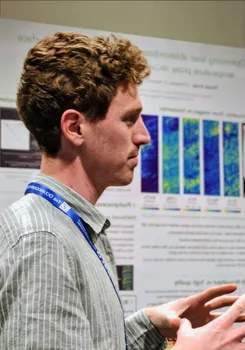
Both physical and biological processes alter the chemical or isotopic composition of natural materials, typically in response to the ambient conditions at the time of formation – such as the high temperatures and pressures as a feldspar grain crystallises, or the temperature, salinity and pH of sea water as a coral grows.
These compositional variations can be used to reconstruct past environmental conditions, or to understand the processes that have shaped the Earth.
Many of these properties are particularly interesting at the micro scale, and laser ablation–based methods enable analysis at the scale of tens of microns.
Methods & analytical experience
I primarily use laser-ablation–based techniques for high-resolution geochemistry, including major and trace element analysis in-situ isotopic systems, and geochronology.
I also have experience with scanning electron microscopy, sample preparation for microanalysis, and developing software for data processing and reproducible research.
More details on my research page.
Antarctic expedition
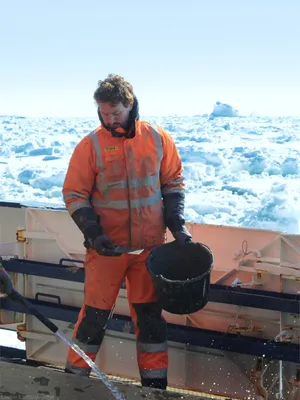
The highlight of my scientific adventures so far was sailing as a micropalaeontologist on a marine geology expedition on the German research icebreaker Polarstern. Read a series of letters I wrote documenting the two months I spent on the East Antarctic coast here.
Photo shows me engaged in the glamorous job of "deck monkey", clearing mud off the deck (though with a nice view).
Teaching & outreach
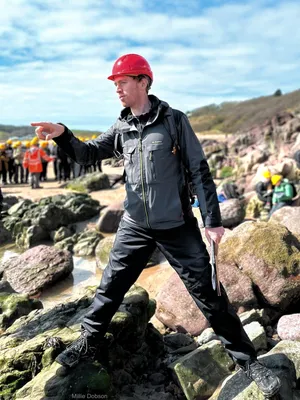
I've helped deliver practical sessions covering palaeoceanography, ocean biogeochemistry, geological mapping, statistics, spectral analysis, R and MATLAB, and field courses (my favourite) on the Jurassic Coast and in Pembrokeshire.
I've also talked about ocean temperature at the Southampton Science and Engineering Festival, about corals at the British Science Festival, and given a talk on my Antarctic research at the Pint of Science festival in Southampton.